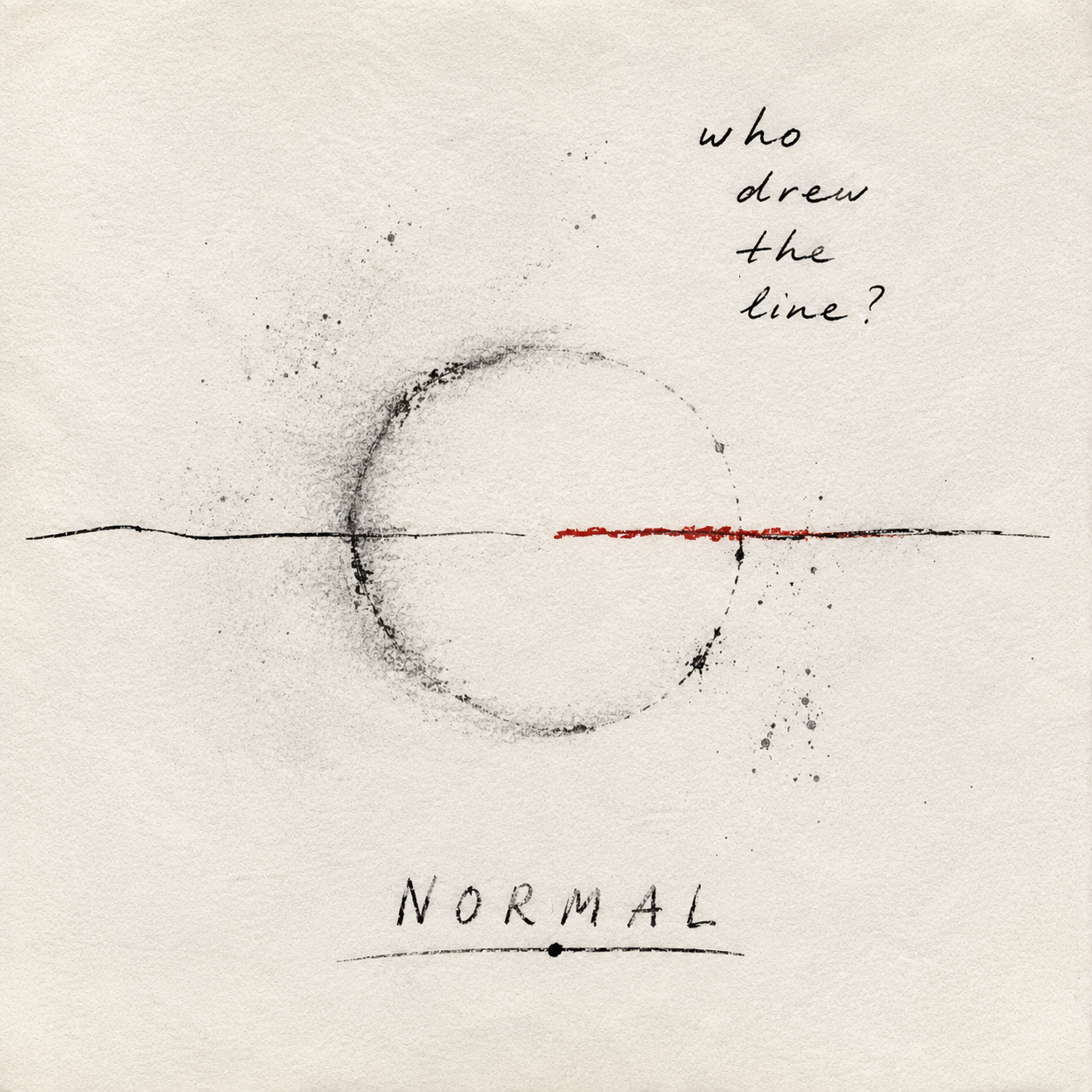
Who decided what normal looks like?
Normal is one of the quietest words in medicine.
It doesn't announce itself.
It sits inside reports.
Reference ranges.
Diagnostic criteria.
Clinical trials.
Algorithms.
Guidelines.
Textbooks.
A result is normal.
A result is abnormal.
A body is within range.
A body is outside it.
And because the word sounds objective, we rarely stop to ask: “Who made the line?”
This is the second specimen of a series of blogs in which I have decided to investigate bias in medicine (not only) following what I call “the microscope and the poem method” .
It is not an opinion piece.
Not a manifesto.
It is an examination.
THE NUMBER
In laboratory medicine, “normal” is often operationalised through a reference interval. A common approach is to define the central 95% of values observed in a selected reference population.
That sounds reassuringly mathematical. But mathematics does not choose the population. People do!
Who is healthy enough to enter the reference population?
Who is excluded?
Which age?
Which sex?
Which physiological state?
Which medications?
Which ancestry?
Which stage of life?
Which laboratory?
Which method?
The number may be precise, but precision does not make the reference neutral.
The range has a population inside it.
THE BODY
For a long time, biomedical research treated the male body as a sufficient proxy for the human body. This was not simply a matter of individual prejudice. It became embedded in research design.
Historically, women were excluded from early clinical trials partly because researchers considered hormonal cycles an unwanted source of variability and because pregnancy created additional safety concerns.
The result was an extraordinary paradox: the female body was considered too complicated to study, and then medicine treated the knowledge generated without it as sufficiently universal.
In 1993, the NIH Revitalization Act made inclusion of women in NIH-supported clinical research a legal requirement, including the expectation that studies be designed to allow analysis of differences in treatment effects.
But inclusion is not the same as understanding.
A woman can be included in a study and still disappear inside its averages.
THE AVERAGE
The average human being does not exist, and yet medicine needs averages.
We need thresholds.
Reference intervals.
Cut-offs.
Baselines.
Definitions.
Without them, clinical decisions become almost impossible.
The problem is not that medicine uses averages.
The problem begins when the average becomes the ideal.
A statistical description quietly becomes a prescription for what a body should be.
And then difference starts looking like deviation.
THE SEX
Sometimes sex matters. Sometimes it doesn't.
That distinction is crucial. Many biological measures differ between men and women, while others do not require separate reference intervals.
Research on laboratory parameters shows precisely this complexity: statistically significant differences do not automatically mean that separate clinical reference intervals are warranted.
My question is: “Where does difference matter, and where have we imagined it does?”
Good science does not begin with the assumption of sameness.
Nor with the assumption of difference.
It begins by looking.
THE WOMAN
Consider what happens when “normal” meets a female body.
A menstrual cycle.
A changing hormone level.
Pregnancy.
Postpartum.
Perimenopause.
Menopause.
A different body composition.
Different reference intervals.
Different physiological states.
These aren't necessarily abnormalities.
They are forms of human biology.
And yet medicine has often had difficulty distinguishing between different and disordered.
What if something has been labelled normal because we have become accustomed to women enduring it?
What if something has been labelled abnormal because the reference point was never built to accommodate it?
And what if the problem is not the body but the category?
THE LANGUAGE
Normal is not only a medical word.
It is a linguistic achievement.
Once something is called normal, we stop asking questions.
Normal pain.
Normal bleeding.
Normal fatigue.
Normal ageing.
Normal mood.
Normal weight.
Normal response.
Normal behaviour.
The adjective can become a sedative.
It tells us nothing to see here!!!
And this is where language and medicine become entangled. Because what we call something changes what we notice about it.
The word normal can describe. But it can also close the investigation.
THE THRESHOLD
Every diagnostic threshold creates two worlds.
Above and below.
Positive and negative.
Normal and abnormal.
But bodies do not necessarily respect our lines.
Disease can begin before a threshold.
A person can suffer while every measurement remains “normal.”
A value can be technically abnormal and clinically irrelevant.
A population can contain enormous variation while the reference interval remains a single frame.
The threshold is useful.
But it is not nature speaking.
It is a decision about where to draw the line. And decisions have consequences.
THE PATIENT
Imagine being told: “Your results are normal.”
The sentence can be a relief.
It can also be devastating, because normal can mean your test did not cross this particular threshold.
It does not necessarily mean you are not suffering.
The distinction matters.
The patient lives in the space between those two statements.
And sometimes the patient is the first person to notice that something is wrong precisely because the system has not yet learned how to name it.
That was my inquiry behind the first specimen of the series on pain: “How many women have had to become experts in their own suffering before medicine believed them?”
Normal takes us one step backwards.
Before belief comes recognition.
Before recognition comes categorisation.
Before categorisation comes the line.
But who drew it?
THE ALGORITHM
Now we teach machines to classify.
Normal.
Abnormal.
Low.
High.
Risk.
No risk.
AI can help medicine recognise patterns beyond human capacity.
But the machine still needs categories.
And categories come from us.
If our historical datasets contain incomplete populations... If our reference ranges were built from particular populations... If clinical records carry our assumptions... If diagnostic labels encode historical patterns... then an algorithm can reproduce a definition of normal with extraordinary efficiency.
The machine does not need to know why the line was drawn. It only needs to learn the line.
One of the most important questions for medical AI, according to me, is not: “Can the machine recognise abnormality?”
But: “Who taught it what normal is?”
THE MIRROR
We call some bodies normal.
Some minds normal.
Some ways of speaking normal.
Some lives normal.
Some careers normal.
Some emotions normal.
Some forms of ageing normal.
Some ways of grieving normal.
Normal is one of the ways we make the unfamiliar feel wrong.
We must turn the microscope around and ask ourselves:
What do I call normal?
Who taught me?
What have I stopped noticing because I have named it normal?
THE QUESTION BEFORE MEDICINE
Perhaps the question isn't simply “what is normal?” but “Normal according to whom?”
And before that:
Who was studied?
Who was excluded?
Who was averaged?
Who was measured?
Who was named?
Who was believed?
Who was made into the reference?
Every reference point has a story.
And every story has a body behind it.
WHAT I AM LEFT WITH
I began this investigation thinking about women. I end it thinking about the word normal.
The problem is not simply that women were excluded from medicine, it is that we created systems capable of turning a particular experience into a universal reference. Once that happens, everyone who differs from the reference becomes a little harder to see.
Maybe inclusion begins earlier than representation.
Maybe it begins before we decide what normal is. Before we draw the line. Before we name the deviation. Before we make difference into disease. Before it becomes medicine, we have to look!!!
I have explored the potential before it emerges in BEFORE IT BECOMES MEDICINE. WHAT ALLOWS SOMETHING TO COME ALIVE? IT IS NOW AVAILABLE here.
If you’re interested in learning more about my services and would like to discuss any consultancy, workshops, talks, please reach out.
Consider also subscribing to the newsletter to stay updated and receive weekly inspiration.
Every month, I spend hours and resources for you to receive both the newsletter & blog regularly and free. A thoroughly one-woman labor. If this labor makes your own life more livable in any way, please consider aiding its sustenance with a one-time or loyal donation. Your support makes all the difference. Donation link here.