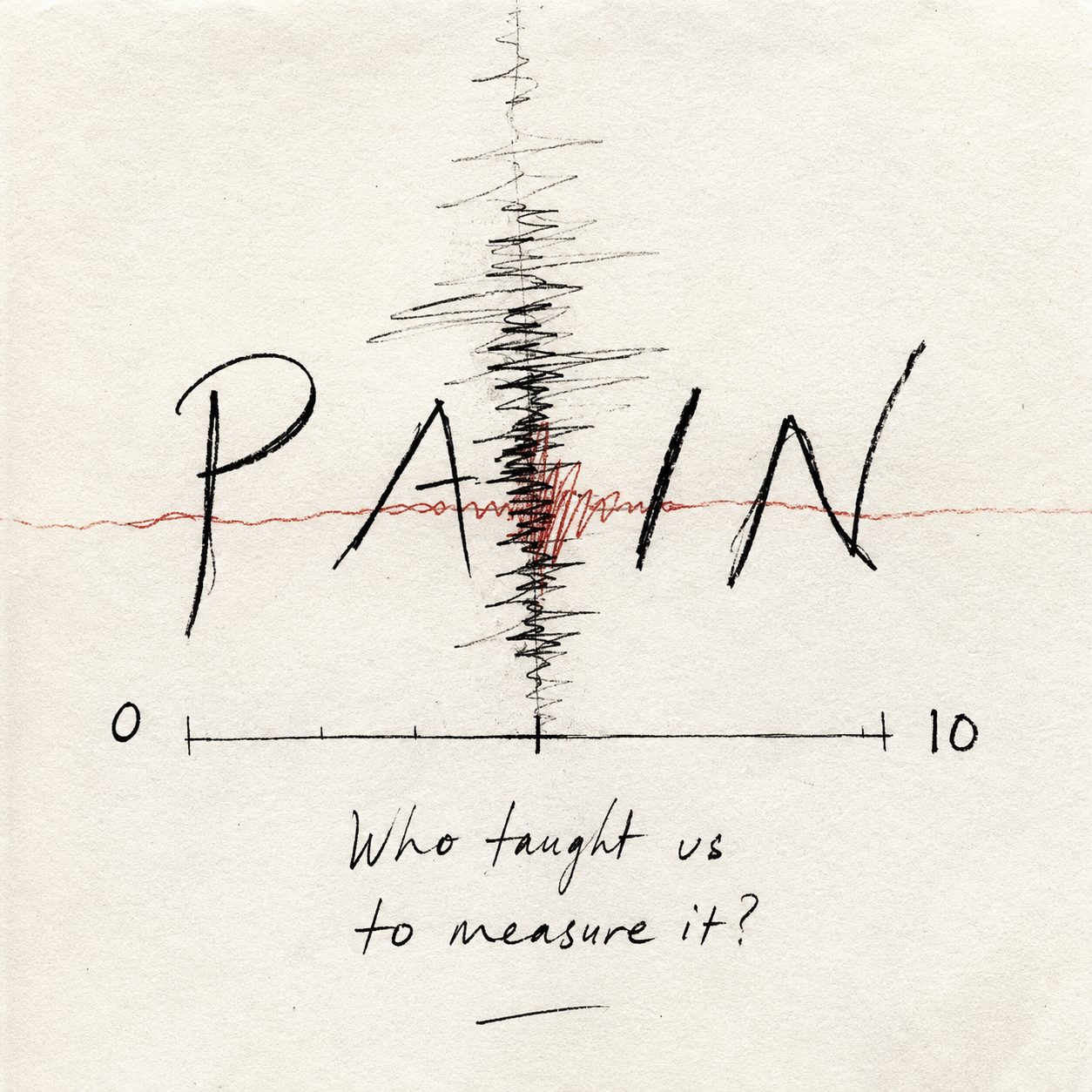
This is the first of a series of blogs in which I have decided to investigate bias in medicine (not only) following what I call “the microscope and the poem method” .
It is not an opinion piece.
Not a manifesto.
It is an examination.
I have become interested in what happens when something as apparently universal as pain isn't experienced, studied, described, measured or treated universally.
Pain seems like one of the most obvious things in medicine.
Something hurts.
We measure it.
We diagnose it.
We treat it.
But what happens when we put the word itself under a microscope?
Not only the biology of pain.
But the research.
The measurement.
The language.
The clinical encounter.
The treatment.
The patient.
The algorithm.
The system.
By the time pain becomes medicine, it has already passed through many human interpretations.
And none of them are entirely neutral.
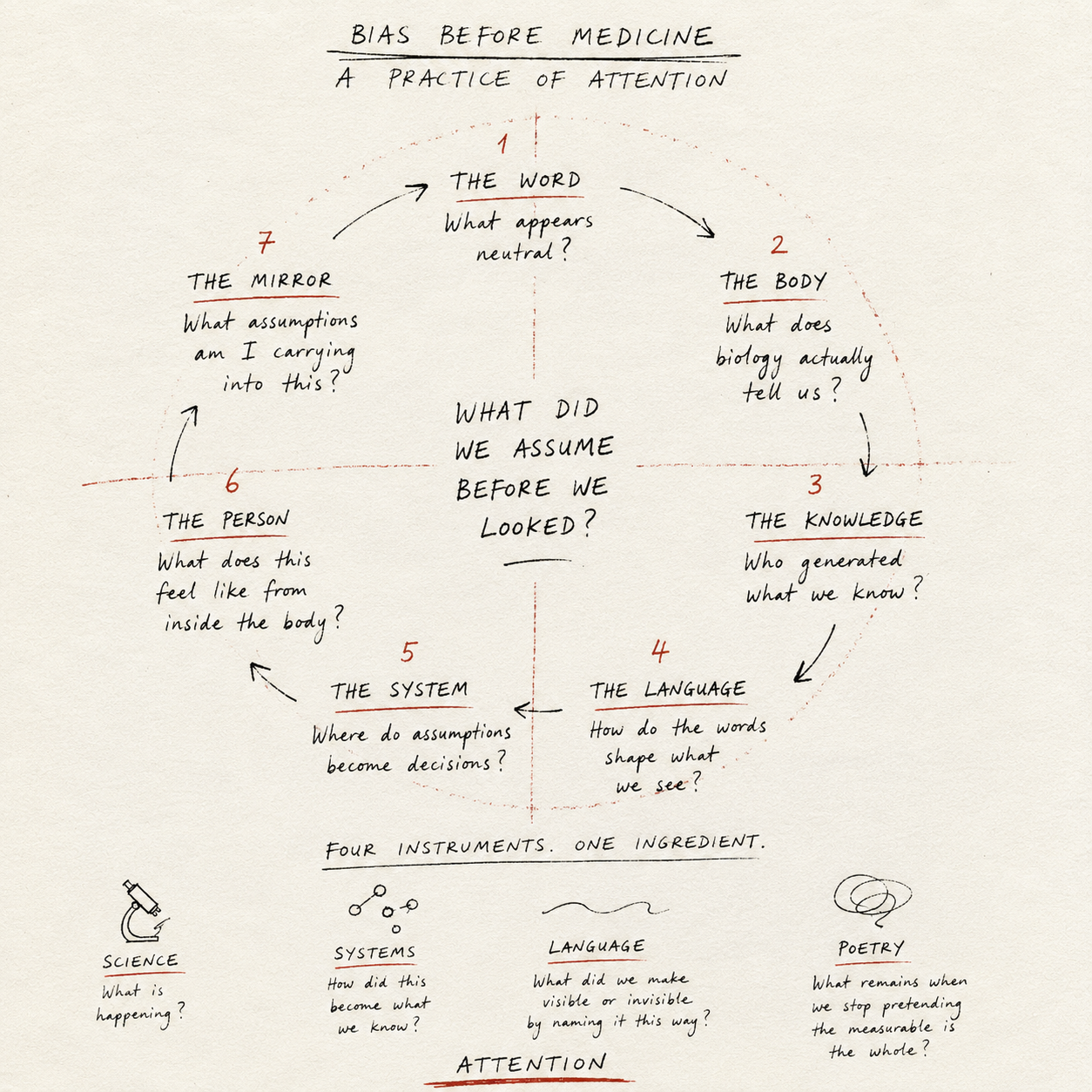
What follows is my investigation Bias Before Medicine using the microscope and the poem method (which I developed as a practice of attention).
THE BODY
Is pain the same in every body?
Pain is not simply a signal travelling from tissue to brain.
It is a complex biological and lived experience, shaped by neurological, immune, hormonal, genetic and psychosocial processes.
Research has identified meaningful sex differences in pain prevalence, sensitivity and pain-modulation mechanisms. Women experience a higher burden of many chronic pain conditions, although the mechanisms are complex and cannot be reduced to a simple male/female binary.
My first question is not whether women experience pain differently, rather why we assume that one model of pain would be enough.
THE RESEARCH
Whose bodies generated our knowledge?
For years, preclinical pain research relied disproportionately on male animals, despite women carrying a greater burden of many chronic pain conditions.
A 2020 Nature Reviews Neuroscience review highlighted the historical predominance of male animals in pain research. And a review of research published in Pain between 2015 and 2019 found that half of the preclinical papers examined used male animals only. This creates a question much larger than representation: What happens when the bodies generating the evidence are not the bodies receiving the medicine?
The bias does not need to be deliberate.
It can simply be inherited.
Precedent becomes evidence.
Evidence becomes standard.
Standard becomes medicine.
THE MEASUREMENT
What exactly are we measuring when we ask someone to rate pain from 0 to 10?
The number gives us something enormously useful: comparability.
But does it give us the whole experience?
Intensity.
Duration.
Fear.
Exhaustion.
Sleep.
Work.
Sexuality.
Mobility.
Anticipation.
The knowledge that it will happen again tomorrow.
A number can be precise without being complete. And even the language surrounding pain may differ between men and women.
So we have to ask: When we measure pain, are we measuring pain, or the person's ability to translate pain into the language our system recognises?
THE LANGUAGE
What happens when pain acquires a gender?
Words do not merely describe a patient. They shape the record of the patient. Research has found gendered differences in the language used in medical records, including greater attention to emotion in descriptions of female patients. Women have also historically been more likely to have pain psychologised or interpreted through stereotypes of emotionality.
When a woman says “it hurts,” what else does the listener hear?
Painful.
Anxious.
Emotional.
Exaggerating.
Hormonal.
Difficult.
Or simply: in pain. The distinction matters because once language enters the medical record, it can become part of the evidence through which the next person sees the patient.
THE CLINIC
Does the same pain receive the same response?
Large observational research has found sex differences in pain treatment in emergency departments, including lower likelihood of receiving analgesia among female patients even after accounting for reported pain and other factors.
This does not prove that every difference is caused by conscious discrimination but it makes the difference impossible to ignore.
If the pain score is the same, what else are we seeing?
THE MEDICINE
What happens when pain becomes a drug?
We tend to ask if it works. But perhaps we should ask for whom?
Does it work equally well across sexes?
At the same dose?
Through the same mechanism?
With the same adverse effects?
Across different hormonal states?
Across different pain conditions?
Were both sexes adequately represented in the research?
Were differences analysed?
Were they reported?
The point is not to assume that every biological difference is clinically important. The point is to make sure we have looked before deciding that it isn't.
THE PATIENT
What happens when the patient knows before the system does?
This, to me, may be the most human part of the investigation.
A person experiences something. They describe it. The test is normal. They return. They describe it again. They begin tracking symptoms. Reading. Comparing. Learning. Finding specialists. Learning which words make people listen. Learning when to insist. Learning when not to. Eventually they may become extraordinarily knowledgeable about their own body. Not because they wanted another degree. Because they needed one.
How much expertise must a patient acquire before the system is willing to believe what the patient already knows?
THE ALGORITHM
Whose way of seeing are we teaching machines?
AI promises to help medicine see patterns we cannot. But AI learns from what we give it. If historical research was unevenly represented...
If medical records contain gendered language...
If diagnoses were delayed...
If certain symptoms were repeatedly dismissed...
If “normal” was defined through incomplete populations... then the machine inherits a history.
Is the algorithm biased? Whose way of seeing did we teach it?
QUALITY
For whom does the system work?
We often define healthcare quality through:
Safety.
Efficacy.
Consistency.
Accuracy.
Timeliness.
But, for whom does the system work, really?
A system can be technically excellent and still produce systematically different experiences or outcomes across populations.
I like to think that inclusion isn't something we add to quality. To me, inclusion is one of the conditions of quality.
THE BLIND SPOT
After following pain through all these lenses, I don't think the conclusion is simply women are not believed. That is too easy!
Pain is interpreted repeatedly before it ever becomes treatment.
Biology interprets it.
Research interprets it.
Measurement interprets it.
Language interprets it.
Clinicians interpret it.
Algorithms may interpret it.
And each interpretation carries assumptions.
What have we built into the system that makes some pain easier to recognise than other pain?
That question implicates all of us.
THE QUESTION BEFORE MEDICINE
Before the diagnosis what did we notice?
Before the evidence who was studied?
Before the measurement what did we decide was measurable?
Before the treatment whose experience shaped the medicine?
Before the algorithm whose history became the data?
Before the word normal who defined it?
And before all of them what did we assume before we looked?
I have explored the potential before it emerges in BEFORE IT BECOMES MEDICINE. WHAT ALLOWS SOMETHING TO COME ALIVE? IT IS NOW AVAILABLE here.
If you’re interested in learning more about my services and would like to discuss any consultancy, workshops, talks, please reach out.
Consider also subscribing to the newsletter to stay updated and receive weekly inspiration.
Every month, I spend hours and resources for you to receive both the newsletter & blog regularly and free. A thoroughly one-woman labor. If this labor makes your own life more livable in any way, please consider aiding its sustenance with a one-time or loyal donation. Your support makes all the difference. Donation link here.