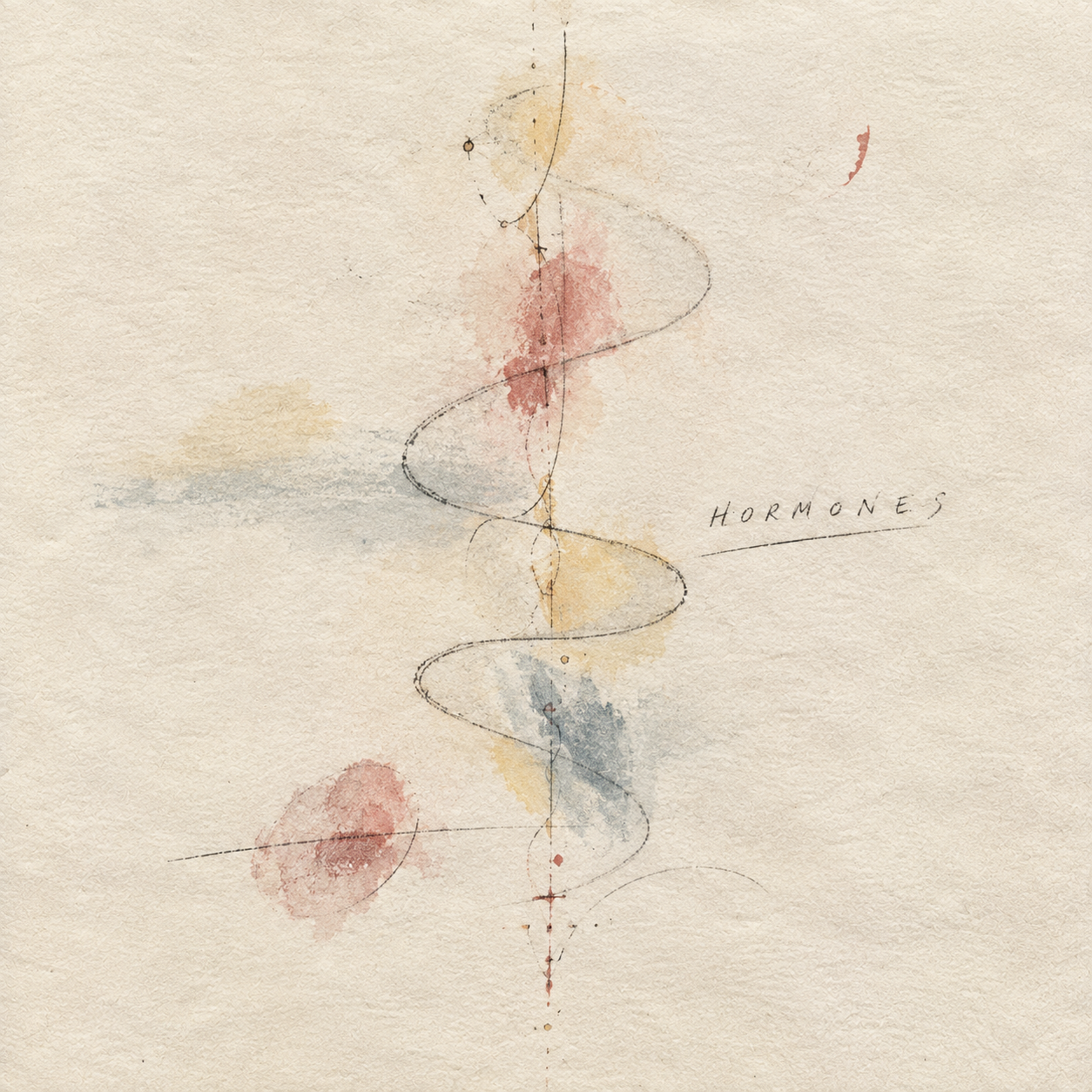
Hormones - The biology we turned into a judgement.
This is the third specimen of a series of blog I am curating on bias before medicine. The first was on pain, the second one on the so called normal and this one will be on hormones.
These are not opinion pieces, or manifestos, they are investigations using the method I call “the microscope and the poem”, a practice of attention.
There are words that begin in science and somehow escape into everyday life. Hormonal is one of them.
“You're being hormonal.” It sounds almost harmless. A throwaway explanation. A little joke. A way of saying: “this isn't really you.”
But listen to what the word has come to carry.
Too emotional.
Too sensitive.
Irrational.
Unpredictable.
Difficult.
A biological process has become a character judgement.
That is where I want to begin.
Not with hormones as the problem.
But with the word hormonal.
How do we start? Simply by putting it under the microscope.
Hormones are chemical messengers. They participate in an extraordinary number of processes throughout the body: metabolism, reproduction, growth, stress responses, sleep, mood, immune function and much more.
There is nothing uniquely female about having hormones. There is nothing uniquely female about hormonal fluctuation either.
And yet the cultural imagination has attached something very particular to the word.
Hormonal became feminine. And feminine became unstable.
That history matters.
Because language does not simply describe biology.
It teaches us how to interpret it.
The body
For a long time, hormonal variation was treated as a scientific inconvenience. The menstrual cycle was imagined as a source of variability that could make research more complicated. That assumption had consequences. Women were historically excluded from important areas of biomedical research, partly because researchers worried that hormonal fluctuations would introduce unwanted variability. That rationale has since been challenged: evidence does not support the idea that female biological cycles simply make research unusably variable.
Think about the strange circularity of this. We did not fully study the female body because it was thought to be too complicated.
Then we knew less about the female body.
Then the absence of knowledge could look like evidence of difference.
The body was not too complicated.
Our science was not yet complex enough.
The word
Something happens when hormonal leaves the laboratory.
It becomes shorthand.
“She is hormonal.” Not her oestrogen is changing. Not her progesterone is changing. Not there may be a physiological process worth understanding.
Instead she is hormonal.
The biology has moved from something happening to and within a body to something that supposedly explains the person.
That is a remarkable transformation.
A molecule becomes a mood.
A physiological process becomes a personality.
A body becomes a stereotype.
And suddenly we are no longer talking about endocrinology.
We are talking about power.
The woman
Consider how differently we have learned to speak about male and female hormones.
Testosterone can become strength. Drive. Performance. Vitality.
Oestrogen can become mood. Cycles. PMS. Instability.
The point is that biology never arrives in language untouched.
We attach meanings to it.
We make metaphors.
We make assumptions.
And sometimes those assumptions travel quietly into medicine.
Menopause
Few places make this more visible than menopause.
At different points in medical history, menopause has been framed as deficiency, disease, risk, decline, transition, normal life stage and as something to be treated or managed.
The history of its medicalisation is complex, involving changing scientific knowledge, pharmaceutical developments, cultural ideas about ageing and femininity, and commercial interests.
The danger is not simply medicalising something natural.
There is another danger too: “demedicalising” suffering.
If we decide menopause is simply “normal”, we can make the symptoms of women who need help disappear.
Some women experience little disruption. Others experience profound symptoms. Both can be true. The body refuses our neat categories.
Hormones disturb our desire for simple explanations.
The pharmaceutical system
Hormones have also become medicines. They can prevent pregnancy. Treat infertility. Manage symptoms. Replace hormones. Suppress hormones. Alter hormonal signalling. Treat endocrine disorders. The pharmaceutical history of hormones is extraordinary.
But every medicine carries a question before it reaches the patient: what are we trying to correct?
A deficiency?
A disease?
A risk?
A symptom?
A deviation from an expected body?
Or discomfort with a body that does not behave according to the norm we have constructed?
The research paper
There is another irony here. We once worried that women's hormonal cycles would make research too complicated. But the more interesting scientific question may be: what have we missed by not studying the complexity?
Hormones interact with sex, age, physiology, disease, medication, environment and many other variables. They do not operate in isolation. Neither does the person carrying them.
Research increasingly recognises sex as a biological variable and the importance of considering hormonal states in understanding health and treatment. Yet important gaps remain in how sex-specific and hormone-related findings are reported and translated into practice.
The language
This is where the microscope meets the poem.
What interests me is not only whether hormones influence behaviour. The question is what happens when we take a biological explanation and turn it into a judgement.
When hormonal becomes a way of saying I don't have to listen to you.
When menopausal becomes you're past your useful years.
When PMS becomes you're not being rational.
When a physiological process becomes a reason to distrust the person experiencing it.
That is bias before medicine.
It happens before diagnosis.
Before treatment.
Before the prescription.
The patient
Imagine what happens when you repeatedly hear that your experience is hormonal.
You begin to wonder is it my body?
Is it my mind?
Am I exaggerating?
Am I difficult?
Should I wait?
Should I explain it differently?
The patient begins carrying not only the symptom but the interpretation of the symptom.
That is a burden medicine rarely measures.
The algorithm
And now we are teaching machines to read bodies.
What happens when the language we inherited becomes data?
If our historical records contain assumptions about women's bodies, will an algorithm simply learn them?
If “hormonal” has been used as a shorthand for emotional instability, what happens when that shorthand becomes encoded in a dataset?
The machine does not need to be sexist. It only needs to learn from enough human history.
The mirror
Where do you participate in the bias?
When do you use biology as an explanation too quickly?
When do you hear emotion and stop listening for information?
When do you treat fluctuation as noise?
When do you confuse difference with dysfunction?
When does a word become so familiar that you stop asking what it is doing?
The work is not to become bias-free (which is impossible). The work is to become more difficult to fool.
Including by ourselves.
The question
Hormones are molecules. But hormonal is a story.
And stories have consequences.
So before we make the next judgement, the next diagnosis, the next protocol, the next dataset, the next algorithm, we need to pause.
Put the word under the microscope.
Then put it inside a body.
Then inside language.
Then inside history.
Then inside medicine.
And ask when did biology become a judgement?
I have explored the potential before it emerges in BEFORE IT BECOMES MEDICINE. WHAT ALLOWS SOMETHING TO COME ALIVE? IT IS NOW AVAILABLE here.
If you’re interested in learning more about my services and would like to discuss any consultancy, workshops, talks, please reach out.
Consider also subscribing to the newsletter to stay updated and receive weekly inspiration.
Every month, I spend hours and resources for you to receive both the newsletter & blog regularly and free. A thoroughly one-woman labor. If this labor makes your own life more livable in any way, please consider aiding its sustenance with a one-time or loyal donation. Your support makes all the difference. Donation link here.